







A Comprehensive Student Guide for 2026-2027
Study in Georgia, Europe
Main Headlines
Georgia in Brief
Advantages of Studying in Georgia
Cultures in Georgia
Cost of Living in Georgia
Education Language in Georgia
Programs Available in English
Recognized Georgian Universities
University of Georgia
Ilia State University
Tbilisi State Medical University
Georgian Technical University
Caucasus International University
European University
Georgia Aviation University
Ivan Tbilisi State University
Black Sea International University
Advantages of Studying in Georgia
When the Studies Start in Georgia?
Disadvantages of Studying in Georgia
Studying Medicine in Georgia
Comparing Studying between Georgia and Ukraine
Comparing Studying between Georgia and Turkey
Comparing Studying between Georgia and Northern Cyprus
Scholarships in Georgia
Medicine studies Average Acceptance Rate in Georgia
Holders of British Secondary School Certificates
Why Choose the :Global Education LLC” to Study in Georgia?
Study in Georgia Requirements
Apply Steps for Study in Georgia
Visa and Residency
Why Are Arabs Attracted to Tourism in Georgia?
Study in Georgia Advantages
Steps required to apply for study in Georgia
Comprehensive Student Guide Study in Georgia (Europe) for 2026 - 2027
Majors and Prices | Guaranteed Admission | Cost of Living | Visa and Residence Permit

Georgia is a country located in the Caucasus region of southeastern Europe and western Asia. Here is some basic information about Georgia:
Geographical Location: Georgia lies between latitudes 41° and 43° North and longitudes 40° and 47° East.
Capital: Tbilisi is the capital and largest city of Georgia. It is situated on the banks of the Kura River.
Language: The official language is Georgian. Small minorities of the population speak Russian, Armenian, and Azerbaijani.
Demographics: Georgia has a population of approximately 4 million.
History: Georgia’s history dates back thousands of years, and it is known for its rich culture and long history. Georgia has been home to multiple civilizations since ancient times.
Politics: Georgia is a democratic republic with a presidential and parliamentary system.
Economy: Georgia’s economy is based on agriculture. Tourism, stunning natural beauty, and historical sites also attract tourists from all over the world.
Culture and Arts: Georgia boasts a rich cultural heritage that includes literature, music, dance, visual arts, and architecture. Georgian singing is world-renowned. Religion: Georgian Orthodox Christianity is the dominant religion in the country and is practiced by the vast majority of the population.
International Relations: Georgia maintains close relations with countries and international organizations and seeks to strengthen economic and political cooperation with its international partners.

Georgia offers many advantages to international students considering studying there, including:
High-Quality Education: Georgia offers a prestigious education system with internationally recognized universities and institutions, providing high-quality study programs.
Low Cost of Study: Studying in Georgia is relatively inexpensive compared to many other European countries.
Diverse Study Programs in Georgia: Georgian universities offer a wide range of study programs in various fields, including medicine, engineering, natural sciences, arts, management, and more.
International Learning Environment: Georgian universities host international students from all over the world, providing opportunities to connect with diverse cultures and build international networks.
Distinguished Geographical Location: Situated in the Caucasus region, Georgia offers opportunities to explore stunning natural landscapes and a rich history and culture.
Safe Environment: Georgia is a safe and friendly country for international students, providing a comfortable and welcoming environment for living and studying.
Career Opportunities After Graduation: After completing their studies, Georgia offers employment opportunities in numerous sectors, such as tourism, logistics, and creative industries.
Low Cost of Living: In addition to the low tuition fees, the cost of living in Georgia is also relatively low compared to other European countries. Guaranteed university admission for international students: Through accredited educational institutions in Georgia, you can easily and conveniently secure your university admission.
Global Education LLC
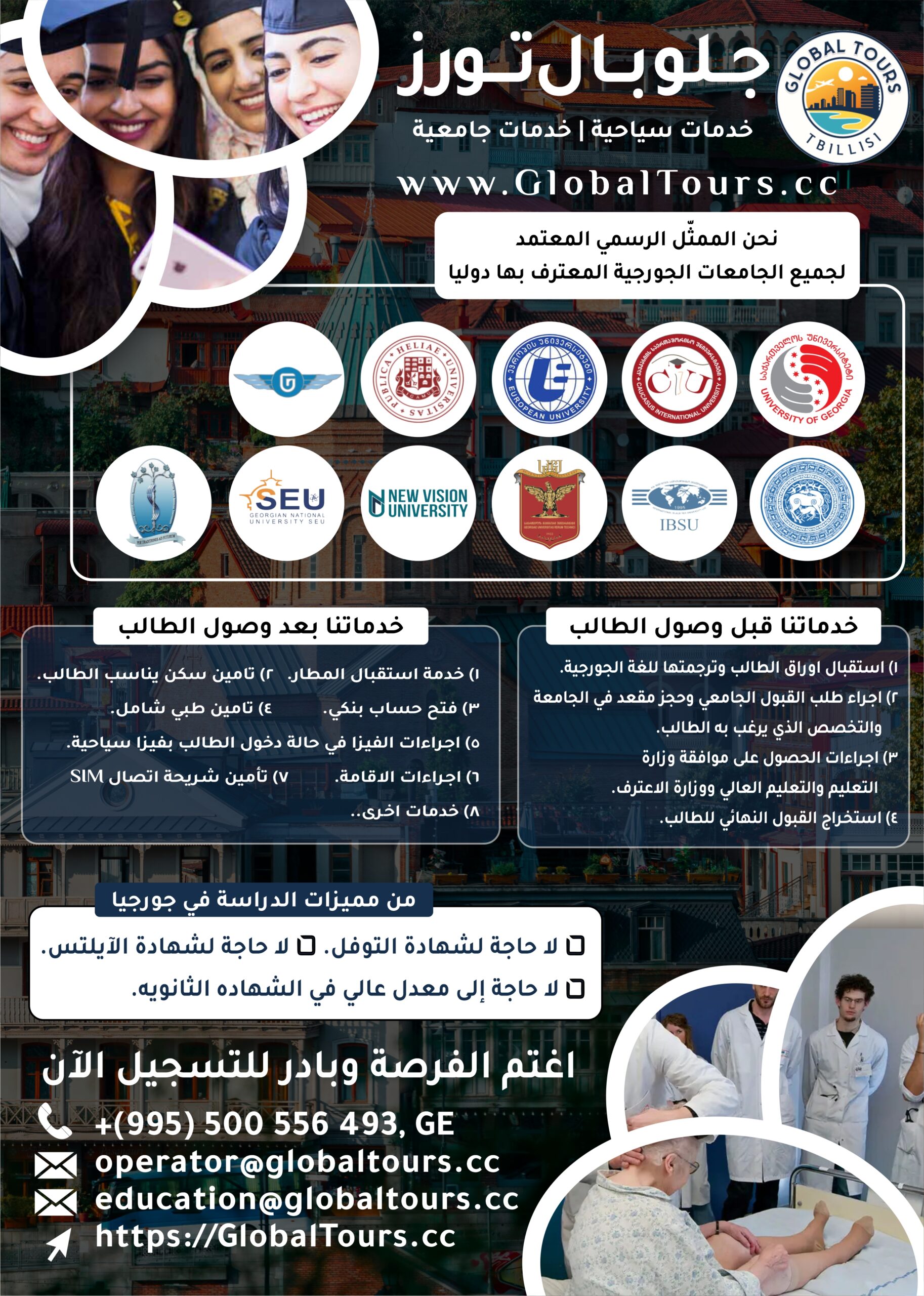
Official representative of recognized universities in Georgia

Don’t hesitate to contact us for more information about available majors and universities in Georgia.
To request our services, chat with us via WhatsApp. We’ll provide advice and assistance every step of the way to obtaining your university admission, student visa, and residency permit.
We guarantee to save you time, effort, and money with our accredited and specialized educational consulting services in Georgia.

Georgia boasts a rich cultural diversity due to its history and the influence of the peoples and civilizations that have inhabited the region. Some of the distinctive aspects of Georgia’s cultural diversity include:
Language and Literature: Georgian is the official language of the country, and Georgia boasts a rich history of literature and traditional songs that reflect its national identity.
Food and Drink: Georgia is renowned for its diverse cuisine, which includes Georgian flatbreads (lahmana), baked vegetables, grilled meats, and seafood.
Architecture and Fine Arts: Georgian architecture is characterized by its diversity and multiple influences, with traces of Byzantine, Ottoman, and Russian architecture visible in various cities and villages.
Music and Dance: Georgia is famous for its rich musical heritage, and Georgian music and dance are integral parts of the country’s cultural life.
Ethnic and Cultural Diversity: Georgia is a multi-ethnic society, where Georgians live alongside ethnic minorities such as Armenians, Azerbaijanis, Russians, Ukrainians, and others.
Georgia boasts a rich cultural diversity due to its history and the influence of the peoples and civilizations that have inhabited the region. Some of the distinctive aspects of Georgia’s cultural diversity include:
These are some of the aspects that highlight the cultural diversity in Georgia, which contribute to making it a destination for exploration and learning about cultural diversity.
The cost of living in Georgia is generally low compared to many other European countries, but costs can vary between different cities and regions within the country. Here are estimates of the costs of some key living items in Georgia:
1. Rent in Georgia: Rental costs vary depending on the area, but generally, a one-bedroom apartment in the city center can be found for between $300 and $600 USD per month, depending on the furniture, appliances, and building age. Rent is lower in areas further from city centers.
2. Living Costs: Living costs are reasonable in Georgia, and food can be purchased at very affordable prices.
A simple meal at inexpensive restaurants costs between $5 and $10 USD. You can also find many Arabic, Turkish, and Indian restaurants and shops that offer halal food.
Many also offer monthly meal delivery subscriptions to student accommodations, ranging from $70 to $200 USD per month, depending on the meals and restaurants.
3. Utilities: Utilities include water, electricity, gas, and internet. They typically cost between $50 and $150 USD per month.
4. Transportation: Public transportation in Georgia is inexpensive, and taxi services are also readily available and reasonably priced. Please note that these estimates may vary depending on the geographic location and desired standard of living, and may change with price fluctuations and inflation.
Therefore, it is important to check the actual cost of living in the city or region where you intend to live before making a final decision.

The cost of living in Georgia is generally low compared to many other European countries, but costs can vary between different cities and regions within the country. Here are estimates of the costs of some key living items in Georgia:
University Housing in Georgia: Some universities offer student housing with meals included at a reasonable price of $150 to $300 per month.
Opportunities are limited, so contact the university or your local office and book early.
Privately Operated Student Housing: You can find Turkish or Indian-run accommodations, offering both private and shared rooms. Prices range from $150 to $400 per month.
Renting an Apartment: This is a preferred option for many international students, but utility bills, internet access, and meal preparation are the student’s responsibility.
The closer the apartment is to a metro station or city center, the higher the rent. Apartments are often furnished with all necessities, such as a refrigerator, washing machine, heater, and stove. Approximate prices are listed below:
– Studio apartment: $200-$300 per month
– One-bedroom apartment: $300-$400 per month
– Two-bedroom apartment: $350-$600
The most suitable option for most students is to share an apartment with friends by splitting the rent.
For example, if three students share an apartment with a rent of $450, each student pays only $150 for accommodation while enjoying the freedom of private living.
Buying an apartment: Purchasing an apartment can be a smart option for those who can afford it, as you can sell it for the same price, or even more, upon graduation. It’s like living for free in your apartment, but don’t forget that maintenance and furnishing are entirely your responsibility. Apartment prices start from $25,000 outside the city and $40,000 within the city. Contact Arab real estate companies for more information.
It’s like living for free in your apartment, but don’t forget that maintenance and furnishing are entirely your responsibility. Apartment prices start from $25,000 outside the city and $40,000 within the city. Contact Arab real estate companies for more information.
The language of instruction in Georgia is often English, especially in disciplines aimed at international students, but some programs are taught in Georgian or Russian.
Majors available to international students at the University of Georgia
| Available specialization | Study duration | Language of study | Grade awarded | tuition fees |
|---|---|---|---|---|
| Human Medicine | 6 years | English | Bachelor | 6000 dollar |
| Dentistry | 5 years | English | Bachelor | 5500 dollar |
| Pharmacy | 4 years | English | Bachelor | 4500 dollar |
| Nursing | 4 years | English | Bachelor | 3500 dollar |
| Computer Engineering | 4 years | English | Bachelor | 4000 dollar |
| Telecommunications Engineering | 4 years | English | Bachelor | 4000 dollar |
| Business Administration | 4 years | English | Bachelor | 4000 dollar |
| English Literature | 4 years | English | Bachelor | 3000 dollar |
| Educational Administration | 2 years | English | Master | 3500 dollar |
| Telecommunications Engineering | 2 years | English | Master | 4000 dollar |
| Business Administration | 2 years | English | Master | 4000 dollar |
| International Law | 2 years | English | Master | 4000 dollar |
Majors available to international students
| Available specialization | Study duration | Language of study | Grade awarded | Tuition Fees |
| Human Medicine | 6 years | English | Bachelor | 5900 dollar |
| Civil Engineering | 4 years | English | Bachelor | 3500 dollar |
| Electrical Engineering | 4 years | English | Bachelor | 3500 dollar |
| Electronics Engineering | 4 years | English | Bachelor | 3500 dollar |
| Computer Engineering | 4 years | English | Bachelor | 3500 dollar |
| Tourism and Hospitality Management | 4 years | English | Bachelor | 3000 dollar |
| Business Administration | 4 years | English | Bachelor | 3000 dollar |
| Natural Resources | 2 years | English | Master’s | 3500 dollar |
| Applied Genetics | 2 years | English | Master’s | 3000 dollar |
| Business Administration | 2 years | English | Master’s | 3500 dollar |
| European, Oriental, Russian, and Eurasian Studies | 2 years | English | Master’s | 3000 dollar |

Majors available to international students
Specializations | Duration | Language | Degree Awarded | Tuition Fees |
|---|---|---|---|---|
| Design | 4 years | English | Bachelor | 4000 dollar |
| Biomedical Engineering | 4 years | English | Bachelor | 4000 dollar |
| Mechanical Engineering | 4 years | English | Bachelor | 4000 dollar |
| Computer Science | 4 years | English | Bachelor | 4000 dollar |
| Business Administration | 2 years | English | Master’s | 4000 dollar |
| Biomedical Engineering | 2 years | English | Master’s | 4000 dollar |
| Design | 2 years | English | Master’s | 4000 dollar |
| Water Engineering | 2 years | English | Master’s | 4000 dollar |
| Viriumology and Brewing | 2 years | English | Master’s | 4000 dollar |
| Agricultural Engineering | 2 years | English | Master’s | 4000 dollar |
| Information Technology | 2 years | English | Master’s | 4000 dollar |
Majors available to international students
| Specializations | Duration | Language | Degree Awarded | Tuition Fees |
|---|---|---|---|---|
| Human Medicine | 6 years | English | Doctor of Medicine | 5500 dollar |
| dentistry | 5 years | English | Bachelor’s | 4500 dollar |
| Business Administration | 4 years | English | Bachelor’s | 3500 dollar |
| International Marketing | 2 years | English | Master’s | 3500 dollar |
| Global politics and security studies | 2 years | English | Master’s | 3000 dollar |
Majors available to international students
| Specializations | Duration | Language | Degree Awarded | Tuition Fees |
|---|---|---|---|---|
| Human Medicine | 6 years | English | Bachelor’s | dollar 5500 |
| dentistry | 5 years | English | Bachelor’s | 4500 dollar |

Majors available to international students
| Specializations | Duration | Language | Degree Awarded | Tuition Fees |
|---|---|---|---|---|
| Civil aviation | 4 years | English | Bachelor’s degree with pilot’s license | dollar 15000 |
| Civil aviation | 2 years | English | Pilot’s License | 30000 dollar |
| Aviation Administration | 4 years | English | Bachelor’s | 3000 euro |
| Aerospace engineering | 2 years | English | Master’s | 3000 euro |

Majors available to international students
| Specializations | Duration | Language | Grade awarded | Tuition Fee |
|---|---|---|---|---|
| Human Medicine | 6 years | English | Bachelor’s | 8000 dollar |
| Dentistry | 5 years | English | Bachelor’s | 8000 dollar |
| Acconting | 4 years | English | Bachelor’s | 3000 dollar |
| Acconting | 2 years | English | Master’s | 3000 dollar |
| Public Health Department | 2 years | English | Master’s | 3000 dollar |

| Specializations | Duration | Language | Grade awarded | Tuition Fee |
|---|---|---|---|---|
| Architecture | 4 years | English | Bachelor’s | 3000 dollar |
| Computer Science | 4 years | English | Bachelor’s | 3000 dollar |
| Business Administration | 4 years | English | Bachelor’s | 3000 dollar |
| Marketing | 4 years | English | Bachelor’s | 3000 dollar |
| Accounting | 4 years | English | Bachelor’s | 3000 dollar |
| Management | 4 years | English | Bachelor’s | 3000 dollar |
| Finance | 4 years | English | Bachelor’s | 3000 dollar |
| Tourism | 4 years | English | Bachelor’s | 3000 dollar |
| Economy | 4 years | English | Bachelor’s | 3000 dollar |
| English linguistics | 4 years | English | Bachelor’s | 3000 dollar |
| American Studies | 4 years | English | Bachelor’s | 3000 dollar |
| International Relations | 4 years | English | Bachelor’s | 3000 dollar |

Quality of education
Georgia has updated its educational curricula to meet European educational standards.
Affordable tuition fees
Tuition fees in Georgia are low compared to other countries such as Türkiye and the rest of Europe.
Direct university admission
In most educational institutions in Georgia, students do not have to enter a preparatory year or take special entrance exams.
Freedom to choose a major
There is no minimum grade requirement to enter any major you wish to study; the main requirement is to successfully complete secondary school.
The fall semester typically begins on September 21st, while new students usually start after October.
The spring semester usually begins on March 14th each year.
These dates are approximate and may vary from university to university.
The bureaucratic systems of some universities, especially public ones.
Some universities do not prioritize the quality of education for international students; therefore, students or their guardians should consult an educational advisor for guidance before applying to any university.
Residency issues for Syrians.
The bureaucratic systems of some universities, especially public ones.
Some universities do not prioritize the quality of education for international students; therefore, students or their guardians should consult an educational advisor for guidance before applying to any university.
Residency issues for Syrians.
Students in Ukraine need to pass the KROK (Unified State Examination) to continue their studies and obtain a degree, while in Georgia, foreign students are not required to take such exams.
Therefore, many students who have fallen into the trap of Ukrainian universities try to transfer their records to Georgian universities.
Places in Turkish medical schools are limited, and there are preparatory Turkish language courses required to meet university admission requirements.
Furthermore, students must pass a competitive entrance exam. Therefore, many students spend several years in Turkey trying to gain admission to medical school. In contrast, in Georgia, students are accepted into their desired specialization before arriving in Georgia and can begin their studies immediately.
Simply put: The certificate in Turkish Cyprus is not recognized (because the state itself is not recognized by most countries).
Some people promote the existence of scholarships, but in reality, universities in Georgia do not offer scholarships at the moment!
When applying to study medicine in Georgia, admission largely depends on a student’s high school GPA. Medical universities in Georgia typically require a minimum GPA of 85% (or its equivalent) for admission to medical programs. This GPA reflects a high level of academic performance that admissions officers expect from applicants, particularly in science subjects such as chemistry and biology.
Students with a GPA higher than the minimum requirement have a better chance of being accepted, especially at prestigious universities like Tbilisi State University and Caucasus International University.
For international students graduating from British secondary schools, admission to study in Georgia is only granted to those who have achieved A level in at least three subjects.
Study requirements may vary depending on the country. The differences lie in the requirements for obtaining a student visa. However, university admission requirements are generally the same for all nationalities, with slight variations from one university to another. Here is a list of general requirements:
Age 17+
High school diploma (12 years of age or older) must include subjects relevant to the chosen field of study, such as biology and chemistry if you wish to study medicine.
Most universities accept any certificate demonstrating English proficiency, or they may administer their own written test or interview, which is generally easy to pass.
A personal interview via video call (Skype) is a requirement for admission.
The interview lasts no more than ten minutes and typically consists of personal questions to assess your English language skills and establish your identity. The interview is recorded.
A copy of your passport and high school diploma translated into Georgian and notarized.
Some universities deal directly with the student from registration until their arrival in Georgia. However, most universities require a licensed intermediary or agency to collect, submit, transfer, and translate documents.
The procedures for applying for university admission and obtaining the necessary legal approvals from the relevant Georgian ministries are as follows:
1) The student must provide us with:
– A clear copy of the first page of their valid passport.
– A clear copy of their high school diploma (grade 12) and transcript.
– A personal email address so that the university administration can officially contact them.
2) Our staff will print these documents and then provide a legal translation into Georgian. The translated documents will then be notarized in Georgia.
3) We will begin the university admission application process and reserve a place for the student and their family in the desired program.
4) The relevant department in the university administration receives the documents and then contacts the student via email to schedule an online interview. This interview is a prerequisite for university admission and reserving a place. This process takes 1 to 3 business days. Alternatively, the student can submit a short video introducing themselves.
5) After receiving university admission, we send a copy to the student and their family. We also initiate the application process to obtain approval from the Ministry of Recognition in Georgia. This process takes 5 to 7 business days.
6) We then proceed with the application process to obtain approval from the Ministry of Higher Education in Georgia. This process takes 15 to 25 business days.
The documents required to apply for a visa and residence permit are:
1) A letter from your university (letter of address) confirming your enrollment as a full-time student.
2) A bank statement showing a balance of at least 4,500 Georgian Lari.
3) A certified and translated copy of your Gulf Cooperation Council (GCC) residency permit (for non-Jordanians and Lebanese).
4) A certified and translated copy of your passport.
5) A letter from your landlord (landlord’s approval).
6) Student health insurance as required by your university.
7) Receipt for visa fees paid at JusticeHouse.
8) Receipt for accommodation fees paid at JusticeHouse.
Georgia boasts a number of factors that make it a unique tourist destination, including:
1. Stunning Nature: Georgia is home to breathtaking natural landscapes, encompassing the Caucasus Mountains, lakes, rivers, and valleys.
2. Rich History and Culture: Georgia is home to numerous ancient religions and cultures, making it an ideal destination for history and culture enthusiasts.
3. Renowned Wines: Georgia is famous for its wine production, and visitors can enjoy winery tours and tastings of various wines.
4. Health Resorts: Georgia features numerous health resorts that utilize thermal springs and natural minerals to offer treatments for patients and visitors.
5. Delicious Cuisine: Georgian cuisine is renowned worldwide for its diversity and popularity, and visitors can savor local dishes in restaurants and cafes.
6. Sports and Outdoor Activities: Visitors can enjoy outdoor sports such as skiing, rafting, mountain biking, and hiking in the mountains and forests.
7. Traditional Markets: Visitors can explore traditional markets and purchase handicrafts and local products. 8. Friendly People: The Georgian people are known for their friendliness and hospitality, making visitors feel comfortable and welcome.
9. Events and Festivals: Georgia hosts numerous events and festivals throughout the year.
And many other reasons…
Submit the required documents, such as a translated high school diploma, passport, and medical certificate.
Apply online through the website of your chosen university.
Obtain a student visa after receiving official acceptance from the university.
Accommodation arrangements: Sudanese students can choose between university housing or renting an apartment in the city.
International Recognition: Degrees from Georgian universities are recognized in most countries worldwide, including those in the European Union.
Diverse Cultural Environment: Georgia offers a rich and diverse cultural environment, which enhances the study experience and helps students adapt quickly.
Ilia State University is one of the largest universities in Georgia and is located in the capital city of Tbilisi. It offers a wide range of academic programs, including science, technology, engineering, and humanities. The university boasts modern infrastructure and diverse programs that cater to students’ needs.
Georgia State Technical University is a leading institution in engineering, science, and technology. Offering majors such as civil engineering, mechanical engineering, and electrical engineering, it is an ideal destination for students interested in technical fields.
Tbilisi State Medical University is renowned for its excellence in medical education, offering programs in human medicine, dentistry, pharmacy, and veterinary medicine. The university enjoys a strong reputation for medical education throughout the region.
Caucasus University is a private university located in Tbilisi, offering programs in the humanities, engineering, technology, and management. The university is renowned for the quality of its academic programs and its diverse learning environment.
The University of Georgia is another private university offering a diverse range of majors in engineering, science, technology, management, and the humanities. It is considered a leading university that caters to the needs of international students.
